
 简体中文
简体中文 English
 русский
 Español
Home / News / Industry News / What is the difference in dynamic balancing requirements between a high-speed and a low-speed Water Pump Motor Rotor Core?
What is the difference in dynamic balancing requirements between a high-speed and a low-speed Water Pump Motor Rotor Core?
The dynamic balancing requirements for a Water Pump Motor Rotor Core differ significantly depending on operating speed. In short: high-speed rotor cores demand much tighter balance tolerances — typically Grade G1.0 or G2.5 per ISO 1940-1 — while low-speed rotor cores generally operate within Grade G6.3 or even G16. The higher the rotational speed, the greater the centrifugal force generated by any residual imbalance, making precise dynamic balancing not just a quality preference but a functional necessity.
Why Dynamic Balancing Matters for Water Pump Motor Rotor Cores
A Water Pump Motor Rotor Core rotates at high velocity within a tightly toleranced air gap. Any mass asymmetry in the rotor — caused by lamination misalignment, uneven die-casting, or shaft eccentricity — creates a centrifugal imbalance force that increases with the square of rotational speed. This means that doubling the speed quadruples the imbalance force, leading to vibration, bearing fatigue, noise, and ultimately premature motor failure.
Dynamic balancing corrects imbalance across two or more axial planes simultaneously, which is essential for rotors with significant stack length. Unlike static balancing — which only corrects single-plane imbalance — dynamic balancing addresses the couple imbalance that causes wobbling at speed. For Water Pump Motor Rotor Cores used in residential, commercial, or industrial pumping systems, achieving the correct balance grade is directly tied to motor longevity and system reliability.
ISO 1940-1 Balance Grade Standards Explained
The internationally recognized standard for rotor balancing is ISO 1940-1, which classifies balance quality into grades from G0.4 (most precise) to G4000 (least precise). Each grade defines the maximum allowable residual specific unbalance (expressed in g·mm/kg). The applicable grade for a Water Pump Motor Rotor Core depends on its maximum operating speed and application sensitivity.
| Balance Grade | Max Specific Unbalance (g·mm/kg) | Typical Application |
|---|---|---|
| G1.0 | 1.0 | High-speed precision pump motors (>10,000 RPM) |
| G2.5 | 2.5 | High-speed water pump motors (3,000–10,000 RPM) |
| G6.3 | 6.3 | Standard industrial pump motors (1,000–3,000 RPM) |
| G16 | 16.0 | Low-speed agricultural or drainage pump motors (<1,000 RPM) |
High-Speed Water Pump Motor Rotor Core: Strict Tolerances Required
A high-speed Water Pump Motor Rotor Core — typically operating above 3,000 RPM, and in some variable-frequency-drive (VFD) systems reaching 6,000 to 12,000 RPM — must meet Grade G1.0 to G2.5 balancing standards. At these speeds, even a residual imbalance of a few gram-millimeters can generate bearing loads measured in tens of newtons, causing accelerated wear and vibration levels that exceed acceptable thresholds.
Key Characteristics of High-Speed Balancing
- Balancing is performed after final assembly, including shaft and any attached components, to account for all rotating mass.
- Correction is made by precision material removal (drilling or grinding) or by adding calibrated balance weights in defined correction planes.
- Two-plane dynamic balancing is mandatory for stack lengths exceeding the rotor diameter, which is common in multi-stage pump motors.
- Vibration velocity must typically be kept below 1.0 mm/s (RMS) at rated speed per ISO 10816.
- Lamination stacking tolerances must be within ±0.02 mm to minimize inherent geometric imbalance prior to correction.
For example, a Water Pump Motor Rotor Core weighing 2 kg running at 9,000 RPM with a G2.5 balance grade can have a maximum permissible residual unbalance of just 5 g·mm total — roughly the mass of a single drop of water offset by 5 mm. This illustrates how extremely sensitive high-speed rotor core balancing truly is.
Low-Speed Water Pump Motor Rotor Core: More Tolerant but Not Ignored
A low-speed Water Pump Motor Rotor Core — operating below 1,500 RPM, such as those found in submersible drainage pumps, irrigation systems, or slow-circulation heating pumps — is typically balanced to Grade G6.3 or G16. While the tolerance is comparatively relaxed, it is incorrect to assume that balancing is unimportant at low speeds.
Key Characteristics of Low-Speed Balancing
- Static balancing (single-plane) may be sufficient for short-stack, low-speed rotor cores with a stack length-to-diameter ratio below 0.5.
- Low-speed rotors are more forgiving of lamination stack variation but still require consistent press-fit and interlock quality to avoid axial runout.
- Vibration velocity limits are less stringent — typically below 2.8 mm/s (RMS) per ISO 10816 Class I or II.
- For G6.3, a 3 kg rotor at 960 RPM is allowed a maximum residual unbalance of approximately 198 g·mm — nearly 40 times more permissive than the high-speed example above.
- Despite the relaxed grade, poor balancing in low-speed pump motors still causes bearing noise, shaft seal wear, and reduced seal lifespan.
Side-by-Side Comparison: High-Speed vs Low-Speed Rotor Core Balancing
| Parameter | High-Speed Rotor Core | Low-Speed Rotor Core |
|---|---|---|
| Typical Speed Range | 3,000 – 12,000 RPM | Below 1,500 RPM |
| ISO Balance Grade | G1.0 – G2.5 | G6.3 – G16 |
| Balancing Method | Two-plane dynamic balancing | Single or two-plane dynamic |
| Max Vibration Velocity | < 1.0 mm/s RMS | < 2.8 mm/s RMS |
| Lamination Stack Tolerance | ±0.02 mm or tighter | ±0.05 mm acceptable |
| Correction Method | Precision drilling / grinding | Weight addition or removal |
| Consequence of Poor Balance | Rapid bearing failure, noise, overheating | Seal wear, vibration, shortened lifespan |
How Rotor Core Design Affects Balancing Difficulty
The geometry and construction method of a Water Pump Motor Rotor Core directly influence how difficult it is to achieve and maintain proper balance. Several design factors are worth considering:
Lamination Quality and Stacking Consistency
Inconsistent lamination thickness or burr heights exceeding 0.05 mm introduce axial and radial mass distribution errors. For high-speed rotor cores, this can make it nearly impossible to achieve G2.5 without extensive correction. Automated progressive die stamping with in-line burr inspection is the preferred manufacturing method for high-speed Water Pump Motor Rotor Cores.
Shaft Press-Fit Concentricity
A shaft pressed into a Water Pump Motor Rotor Core with eccentricity greater than 0.03 mm will introduce inherent imbalance that must be corrected during dynamic balancing — adding cost and time. High-speed applications require shaft-to-bore concentricity within 0.01 mm TIR (Total Indicator Reading).
Die-Cast Aluminum vs Copper Bar Conductors
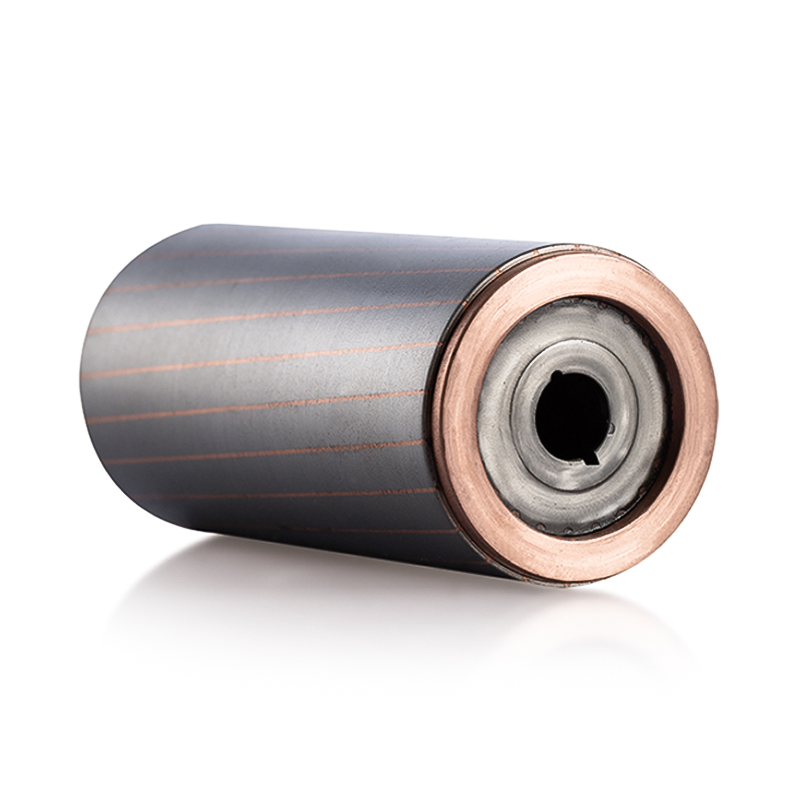
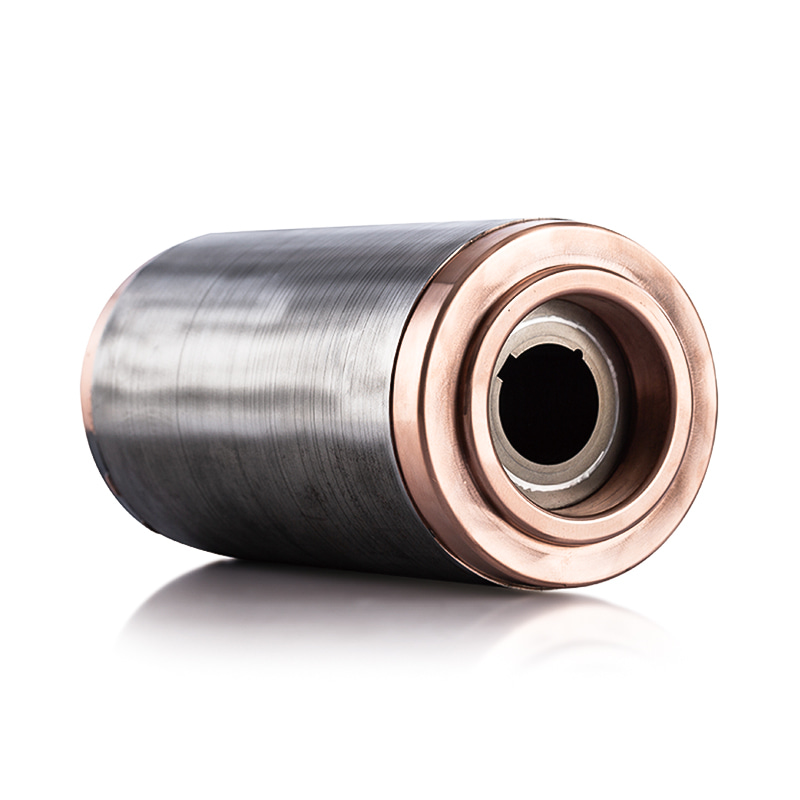
Die-cast aluminum rotor cores are susceptible to internal voids and density variations that can shift the center of mass unpredictably. Copper bar rotor cores, by contrast, offer more consistent mass distribution, making dynamic balancing easier and more repeatable — a meaningful advantage for high-speed Water Pump Motor Rotor Core production.
Practical Recommendations When Sourcing or Specifying a Water Pump Motor Rotor Core
- Always specify the ISO 1940-1 balance grade explicitly in the procurement drawing or technical specification — do not leave it to supplier default.
- Request balancing reports with measured residual unbalance values in g·mm for both correction planes for every high-speed Water Pump Motor Rotor Core batch.
- For VFD-driven pump motors with variable speed ranges, balance the rotor core to the highest expected operating speed, not the nameplate speed.
- Confirm that the supplier performs dynamic balancing after shaft assembly, not just on the bare core, to ensure system-level accuracy.
- For low-speed applications, verify that G6.3 is still being met consistently — even lower-speed rotor cores can develop imbalance issues if lamination bonding or die-casting quality is poor.
The dynamic balancing requirements between a high-speed and a low-speed Water Pump Motor Rotor Core are not merely different in degree — they are different in approach, tooling, measurement precision, and consequence. High-speed rotor cores demand Grade G1.0 to G2.5 with two-plane dynamic balancing, sub-0.02 mm lamination tolerances, and vibration limits below 1.0 mm/s. Low-speed rotor cores operate within Grade G6.3 to G16 and are more forgiving, but poor balancing still leads to mechanical degradation over time. Understanding these differences enables engineers and procurement professionals to specify, evaluate, and source Water Pump Motor Rotor Cores that deliver the performance, reliability, and service life their pump systems require.
Previous article
How does the Motor Stator And Rotor Core compare in energy loss reduction to laser-engraved laminated core designs?
next article
How does the stack length of a Generator Motor Rotor Core influence output power density compared to increasing the rotor diameter?
Related News
-
What are Stator and Rotor Cores? Stator Cores A stator core is the stationary component of an electric motor. It's the part that houses the copper windings, which, when an electric current passes thro...
See Details -
Introduction The modern automobile is a complex machine, and its evolution has been driven by continuous innovation in every component. While internal combustion engines have dominated the industry fo...
See Details -
The Importance of Material Selection for Rotor and Stator Cores in Electric Vehicle Motors In the design of electric vehicle (EV) motors, material selection is a pivotal factor influencing the motor’s...
See Details -
Introduction of automotive motor stator and rotor cores The increasing popularity of electric vehicles and hybrid electric vehicles has brought about significant advancements in automotive technology....
See Details


Zhejiang Jufeng Technology Co., Ltd. © All rights reserved
