
 简体中文
简体中文 English
 русский
 Español
Home / News / Industry News / How does the yoke thickness design of this Electric Vehicle Drive Motor Stator Core balance magnetic flux saturation resistance against overall motor weight and compactness?
How does the yoke thickness design of this Electric Vehicle Drive Motor Stator Core balance magnetic flux saturation resistance against overall motor weight and compactness?
The yoke thickness of an Electric Vehicle Drive Motor Stator Core is one of the most consequential geometric parameters in motor design. The direct answer is this: yoke thickness must be large enough to prevent magnetic flux saturation — which would cause nonlinear losses and torque collapse — yet thin enough to minimize mass and preserve the compact envelope demanded by EV powertrains. In practice, most passenger EV traction motors settle on a yoke thickness ranging from 8 mm to 20 mm, depending on power class, pole count, and the grade of electrical steel used. This balance is not a compromise so much as a precision trade-off governed by electromagnetic, thermal, and structural constraints simultaneously.
What the Yoke Actually Does in a Stator Core
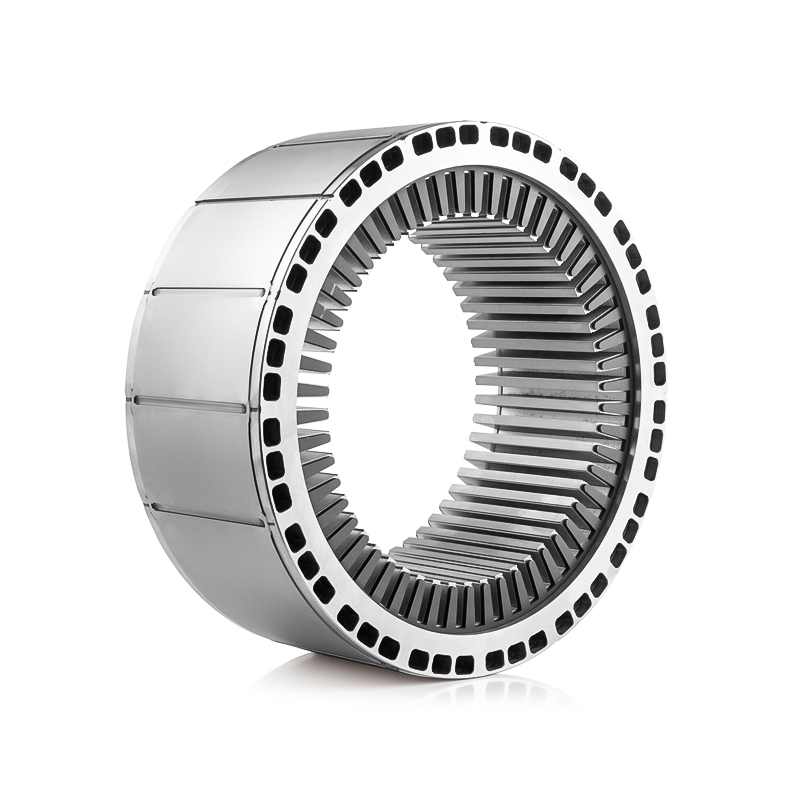
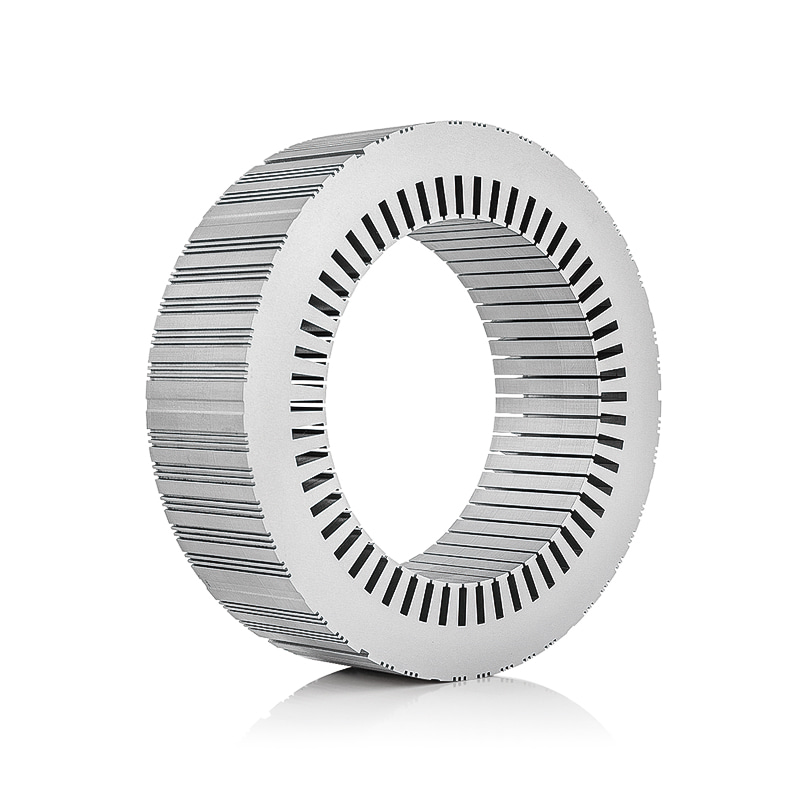
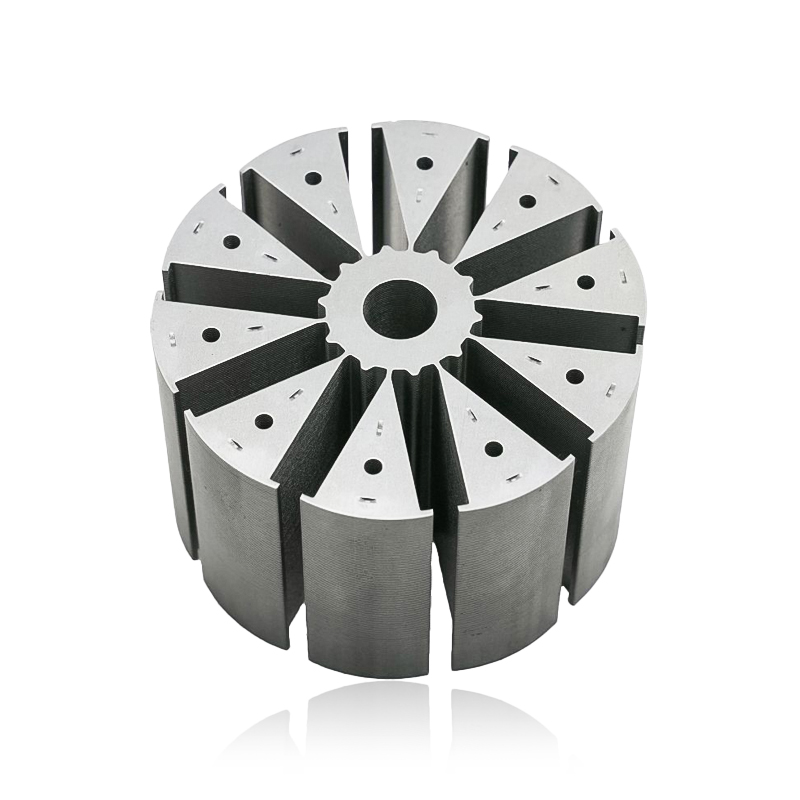
The stator yoke — also called the back iron — is the annular ring that connects all stator teeth and provides a continuous return path for magnetic flux generated by the stator windings. When current flows through the coils wound around the teeth of the Electric Vehicle Drive Motor Stator Core, flux travels down each tooth, crosses the air gap into the rotor, and returns via the yoke in a closed magnetic circuit.
If the yoke is too thin, the cross-sectional area available for flux becomes insufficient. The flux density in the yoke rises beyond the saturation point of the electrical steel — typically above 1.8 T to 2.0 T for M270-35A or 35JN210 grades — causing a sharp increase in core losses, excessive heat generation, and a dramatic drop in permeability. Torque output becomes unstable and efficiency falls sharply, especially at high-speed operation above 6,000 rpm.
The Engineering Formula Behind Yoke Thickness Selection
The fundamental starting point for yoke thickness calculation in an Electric Vehicle Drive Motor Stator Core is the magnetic flux continuity condition. The peak flux in the yoke is approximately half the peak tooth flux (since flux splits in two directions around the yoke), and the minimum yoke thickness ty is derived as:
ty = Φtooth / (2 × Bsat × Lstk)
Where Φtooth is the peak flux per tooth, Bsat is the design flux density limit in the yoke (commonly set at 1.5 T to 1.65 T for a safety margin below saturation), and Lstk is the axial stack length of the core. A higher pole count reduces the flux each yoke segment must carry, which is why high-pole-count motors — such as 8-pole or 10-pole designs common in EV axial or radial flux architectures — can use noticeably thinner yokes than 4-pole motors of equivalent power.
How Electrical Steel Grade Directly Influences Yoke Thickness
The choice of lamination material has a direct multiplier effect on how thin the yoke of an Electric Vehicle Drive Motor Stator Core can be made without sacrificing magnetic performance. Higher-grade, thinner laminations allow the designer to reduce yoke thickness while maintaining acceptable core loss levels.
| Steel Grade | Thickness (mm) | Core Loss at 1.5T / 400Hz (W/kg) | Typical Yoke Reduction vs. 0.50mm |
|---|---|---|---|
| 35JN210 (M270-35A) | 0.35 | ~62 | Up to 15% |
| 35JN300 (M300-35A) | 0.35 | ~75 | Up to 10% |
| 50JN400 (M400-50A) | 0.50 | ~110 | Baseline |
| 20JN1200 (amorphous-like) | 0.20 | ~28 | Up to 22% |
Switching from 0.50 mm laminations to 0.35 mm grade in an Electric Vehicle Drive Motor Stator Core can reduce the required yoke thickness by up to 15%, which in a 200 mm outer-diameter stator translates to a mass saving of approximately 0.8 kg to 1.4 kg — meaningful in a vehicle where every kilogram affects range.
Pole Count as a Lever for Reducing Yoke Mass
Pole count is perhaps the most powerful design variable influencing yoke thickness in an Electric Vehicle Drive Motor Stator Core. In a motor with p pole pairs, each yoke segment only carries the flux from one tooth pitch spanning one pole. As pole count increases, the arc length of each yoke segment decreases proportionally, and so does the flux each segment handles.
- A 4-pole (2p) stator with 36 slots may require a yoke thickness of 18–22 mm to avoid saturation at rated torque.
- An 8-pole (4p) stator of equivalent power and outer diameter can safely reduce yoke thickness to 11–14 mm.
- A 10-pole or 12-pole stator, as used in some Tesla and BYD drive motor designs, may target yoke thicknesses as low as 8–10 mm, saving 20–35% of back-iron mass versus a 4-pole equivalent.
This is why the trend in high-performance EV traction motors has moved consistently toward higher pole counts — not just for torque ripple and efficiency reasons, but because the accompanying reduction in yoke thickness yields a lighter, more compact Electric Vehicle Drive Motor Stator Core without any penalty in magnetic saturation margin.
Thermal and Structural Constraints That Set a Lower Bound on Yoke Thickness
While electromagnetic analysis may theoretically permit very thin yokes, practical manufacturing and thermal management requirements impose a hard lower limit. For an Electric Vehicle Drive Motor Stator Core integrated into a water-cooled motor housing, the yoke also functions as a thermal conduction path, transferring heat from the slot windings to the cooling jacket.
Minimum Yoke Thickness for Structural Integrity
During press-fit or shrink-fit assembly into the motor housing, the stator experiences radial compressive stress. If the yoke is too thin — typically below 6–7 mm for a 200 mm diameter core — the back iron may deform elastically, distorting slot geometry and degrading both winding fill factor and air-gap uniformity. FEA-based structural analysis is routinely used to confirm that the chosen yoke thickness sustains an assembly interference stress below 80–100 MPa, preserving dimensional roundness within ±20 µm.
Thermal Conductivity Requirements
The laminated yoke of an Electric Vehicle Drive Motor Stator Core has an effective radial thermal conductivity of only 1–4 W/m·K (due to inter-laminar insulation layers), compared to 30–40 W/m·K in the axial direction. Reducing yoke thickness increases the thermal resistance between the winding hot spot and the housing coolant, potentially raising the winding temperature beyond the insulation class limit (e.g., Class H: 180°C). Designers typically enforce a minimum yoke thickness that keeps the radial thermal resistance below a threshold consistent with the target winding temperature rise at peak power.
Optimization Methods Used in Modern EV Motor Design
Leading EV motor developers use multi-physics optimization to find the ideal yoke thickness for their Electric Vehicle Drive Motor Stator Core, simultaneously minimizing core losses, mass, and thermal resistance under full operating cycle conditions.
- Finite Element Analysis (FEA): Tools such as ANSYS Maxwell or JMAG are used to simulate flux density distribution across the yoke at peak and rated torque, identifying local saturation hotspots and verifying that B remains below 1.65 T throughout the yoke cross-section.
- Topology Optimization: Parametric sweeps vary yoke thickness from 6 mm to 25 mm across a design space matrix, with outputs including efficiency maps, mass, and peak temperature — allowing Pareto-front identification of the optimal design point.
- Surrogate Modeling: Machine learning regression models trained on FEA datasets can predict yoke performance across thousands of design configurations in seconds, accelerating the convergence on minimum viable yoke thickness for target specifications.
- Drive-Cycle Weighted Loss Evaluation: Rather than optimizing only for peak efficiency, modern EV motor designs evaluate core losses weighted by a standard drive cycle (e.g., WLTP or EPA combined), ensuring the yoke design is optimized for the most frequently visited operating points, not just rated power.
Real-World Design Examples and Benchmarks
Publicly available teardown data and academic publications on production EV traction motors offer concrete benchmarks for yoke thickness decisions in an Electric Vehicle Drive Motor Stator Core:
- The Toyota Prius (Gen 4) traction motor stator uses an 8-pole configuration with a yoke thickness of approximately 10.5 mm and 0.30 mm laser-cut laminations, achieving a power density of over 5.0 kW/kg.
- The Tesla Model 3 rear drive unit stator (hairpin winding, 4-pole) features a yoke in the range of 17–19 mm, consistent with its lower pole count and high peak torque demand.
- High-performance motorsport-derived EV motors targeting power densities above 10 kW/kg use 10-pole or 12-pole stators with yoke thicknesses as low as 7–9 mm, relying on ultra-thin 0.20 mm amorphous or nanocrystalline laminations to prevent saturation at extreme flux densities.
These examples confirm that the optimal yoke thickness in an Electric Vehicle Drive Motor Stator Core is not a fixed value but a design-specific outcome shaped by the interaction of pole count, steel grade, cooling architecture, and application duty cycle. Getting this balance right is one of the defining competencies that separates high-performance EV motor designs from commodity alternatives.
Previous article
How is the insulation system of an Automotive Small Motor Stator Core rated for thermal performance in high-temperature underhood automotive environments?
next article
What role does insulation between laminations play in Motor Stator and Rotor Cores?
Related News
-
What are Stator and Rotor Cores? Stator Cores A stator core is the stationary component of an electric motor. It's the part that houses the copper windings, which, when an electric current passes thro...
See Details -
Introduction The modern automobile is a complex machine, and its evolution has been driven by continuous innovation in every component. While internal combustion engines have dominated the industry fo...
See Details -
The Importance of Material Selection for Rotor and Stator Cores in Electric Vehicle Motors In the design of electric vehicle (EV) motors, material selection is a pivotal factor influencing the motor’s...
See Details -
Introduction of automotive motor stator and rotor cores The increasing popularity of electric vehicles and hybrid electric vehicles has brought about significant advancements in automotive technology....
See Details


Zhejiang Jufeng Technology Co., Ltd. © All rights reserved
